

Kraft Curing Channels CO2 vs. Steam for Canal Block CarciCrete Chambers
Ontario’s Canal Block has deployed one of the most advanced systems to date for curing concrete with carbon dioxide gas. The installation of twin Kraft Curing Systems chambers, 26.7 x 4 meters (88 x 13 feet), at the producer’s Port Colborne operation completes an $8 million investment, ushering binder and process technology from Quebec-based CarbiCrete. The capital outlay positions Canal Block to promote concrete masonry units of markedly lower carbon profile than ones molded with portland cement mixes.
“The CarbiCrete block allows designers to choose a building material with proven durability, fire resistance and energy efficiency, but minimal embodied carbon,” says Canal Block President Durk Bylsma, keen on his company’s role in the introduction of a groundbreaking concrete masonry concept to the Ontario market.
“Province builders can now purchase CarbiCrete blocks to lower embodied carbon in their construction projects,” adds CarbiCrete CEO Jacob Homiller. “Canal Block and the Bylsma family have a long history of manufacturing sustainable building products, and we’re excited to have them as partners as we advance our mission to make concrete a climate solution.”
CO2 is central to CarbiCrete binder chemistry, mineralizing to a permanently sequestered state in cured CMUs. CarbiCrete replaces 100 percent of the portland cement in the mix designs of masonry and hardscape products with comparably ground and graded electric arc furnace steel slag. While widely specified ground granulated blast furnace slag has cementitious value under hydration, EAF slag binds aggregate when exposed to CO2 by forming calcium carbonate. One metric ton of EAF slag binder typically sequesters 150 kilograms of CO2 when used in the CarbiCrete model.
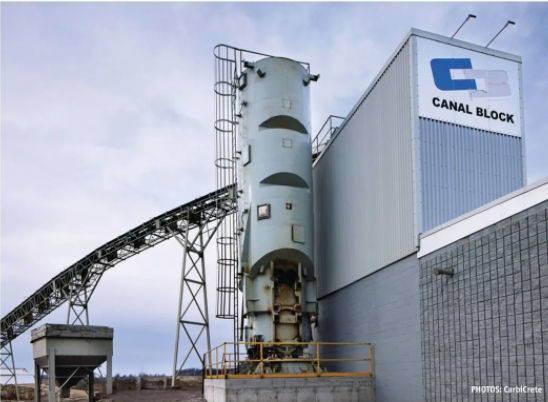
A new dedicated slag silo is fully integrated with Canal Block’s batching system, which is programmed to quickly switch between binder types.
SEAMLESS ADOPTION
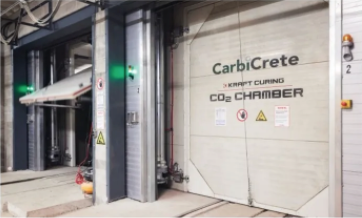
Kraft Curing Systems unveiled the CO2 chamber concept at the 2025 Precast Show in Indianapolis. Approaching their first commercial installation of such equipment, company engineers configured chambers to readily accommodate Canal Block’s pallet rack transfer and crawler rail equipment. The chambers operate at atmospheric pressure and feature insulated metal sandwich panel walls to minimize energy and CO2 loss.
The CarbiCrete production plan included the installation of an external pressure vessel to charge the chambers; it imparts CO2 in two to three hours depending on target gas levels and curing loads. Precision gas analysis instruments integral to Kraft Curing controls track injected CO2 volumes, while mass flow meters yield absorption and sequestration data.
“The challenge found in this project was integrating cutting-edge CO2 curing technology, the required curing enclosures and equipment in traditional block plant infrastructure,” says Kraft Curing Systems Managing Director Michael Kraft. “Working together with Carbicrete and Canal Block, both professional and innovative partners, we were able to achieve excellent results.”
Canal Block is the second North American CarbiCrete partner. It introduced low carbon block to the Ontario market through an initial supply arrangement with Patio Drummond, Quebec peer and inaugural CarbiCrete partner. Patio Drummond has also supported early CarbiCrete block distribution in the U.S. through Maine’s Gagne & Son Concrete Products.
Canal Block and CarbiCrete are compiling carbon volume figures to support an environmental product declaration for Port Colborne plant output. Its global warming potential metrics are poised to be far below those of conventional CMUs, based on GWP factors indicated in Patio Drummond’s premier CarbiCrete block EPD.
CarbiCrete’s first overseas partner is POINT.P, which plans a 2026 opening for a low carbon block production line at its Hauts-de-France plant north of Paris. A key building materials producer and retailer in France, POINT.P is a sister business of Chryso Inc. under Saint-Gobain Group, Paris. — Kraft Curing Systems GmbH, Lindern, Germany, www.kraftcuring.com; CarbiCrete, Lachine, Quebec, www.carbicrete.com
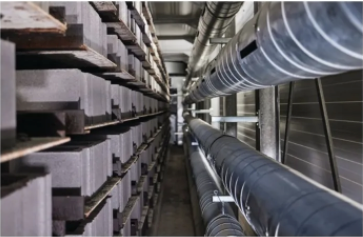
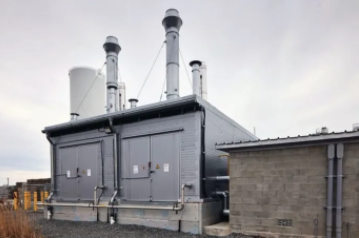
Commercial scale CarbiCrete block production at Port Colborne necessitated the addition of dedicated slag cement silo (opposite page) and pressurized carbon dioxide vessel (left background in lower photo), engineered and calibrated to charge the curing chamber over two- to three-hour cycles. The carbon dioxide gas mineralizes during reaction with the CarbiCrete units’ electric arc furnace slag binder.