

IBF’s Roof Tile Plant Rebuilds Smarter and Stronger with New Curing Technology
More than 40 years of experience in manufacturing concrete roofing tiles was abruptly challenged when a devastating fire broke out in January 2023 at Danish company I·B·F (A/S Ikast Betonvarefabrik). The fire destroyed the tile production facility at the company’s headquarters in Ikast, Denmark, bringing operations to a sudden halt. Fortunately, no lives were lost, and only one employee sustained minor injuries. Yet, from the ashes of the blaze, a transformation began.
The mechanical part of IBF’s tile production had always been a result of in-house innovation. Developed by the company’s own machine division—and backed by the deep technical expertise of owners Mogens and Preben Rosenkilde—IBF had become a leading player in concrete roof tile manufacturing in both Denmark and Poland. Though the production building and machinery were beyond repair, the fire was successfully contained, leaving the adjacent nine curing chambers largely undamaged. While demolition was still underway, IBF’s leadership was already charting a course forward: a complete modernization of its tile production. Thanks to strong backup from its Polish production sites, Danish customers remained unaffected during the transition—delivery reliability was maintained at IBF’s usual high standard.
Modernizing the Curing Process
The decision was made not only to rebuild—but to build smarter. After careful evaluation, IBF opted to convert its existing curing setup from a traditional Last-In-First-Out (LIFO) configuration to a First-In-First-Out (FIFO) system. This shift represented more than just a change in material flow; it was a strategic move to optimize production efficiency, product tracking, and operational safety while ensuring greater product strength and color consistency. Under the old LIFO system, tiles placed into the chambers last were removed first, often leading to uneven curing durations if production was interrupted or batch sequencing changed. With the new FIFO design, tiles now enter and exit in the exact same order. This guarantees consistent curing times for every batch, simplifies scheduling, and reduces handling complexity—ultimately improving product uniformity and plant throughput.
The chambers before the renovation in 2023
To accommodate the installation of a dry-side transfer car—critical for automated, seamless movement of cured tiles to the packaging lines—the existing chambers required shortening. To offset the resulting reduction in curing capacity, IBF expanded its facility to add four entirely new chambers. The final configuration now includes thirteen FIFO curing chambers, each precisely engineered with two insulated doors. This dual-door setup enhances operational flexibility by allowing separate loading and unloading points, improving energy retention within the chamber, and ensuring smoother, safer material flow through the production process.
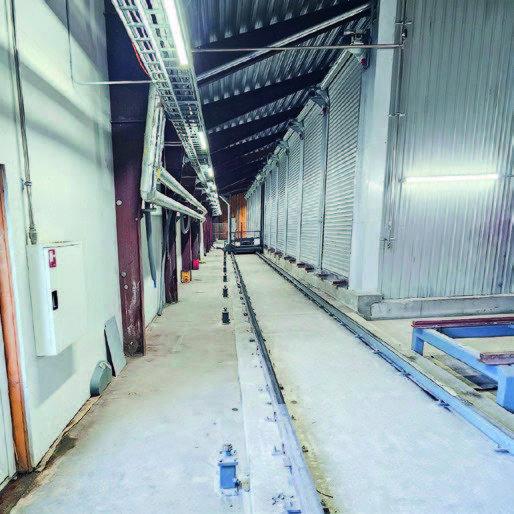
The 13 new FIFO curing chambers with insulated motorised aluminium roller doors
By redesigning the curing system in this way, IBF laid the foundation for a future-proof facility that combines speed, quality, and reliability—ready to meet market demands with maximum efficiency.
With modernization in mind, IBF’s leadership recalled what they had seen at bauma 2022 just months before the fire. At Kraft Curing Systems’ booth, they had witnessed the Quadrix ® curing technology in action—a solution that now, in the wake of reconstruction, presented itself as the ideal choice for their future-ready facility. There, Mogens Rosenkilde and his production team encountered a live demonstration of Kraft’s Quadrix curing technology unlike anything they had seen before. Kraft had constructed a fully functioning Quadrix test chamber at the exhibition, operating continuously throughout the fair with four passages at an impressive 93% relative humidity and a temperature of 35°C. Despite these extreme curing conditions, all chamber surfaces—including walls, ceiling, floor, and ducting—remained completely dry.
For experienced concrete producers like the IBF team, this demonstration was nothing short of groundbreaking. The absence of condensation at such high humidity levels is not only critical for maintaining a consistent curing climate but also prevents corrosion of steel structures, protects sensitive sensors and laser systems, and enhances overall chamber hygiene and durability. The ability to maintain this stable environment in an open demonstration setting convinced IBF that Kraft’s Quadrix system offered a technological leap forward—combining precise curing control with practical operational advantages. For “concrete people,” as Mogens described, seeing this performance firsthand was unforgettable. It offered a clear vision of how IBF’s rebuilt production could achieve faster curing times, superior surface quality, and long-term durability—while operating with the highest standards of efficiency and safety.
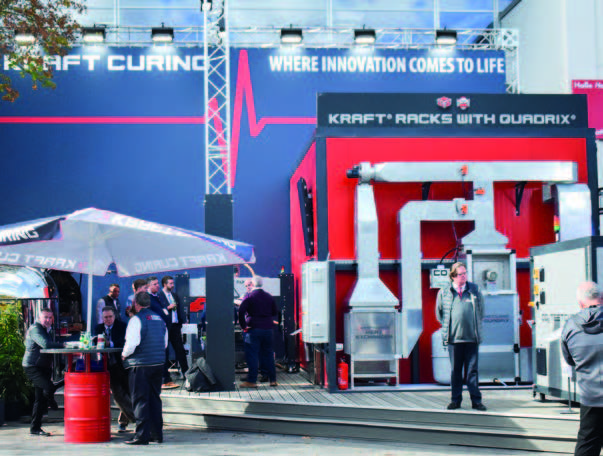
One of the three Kraft Curing bauma stands in 2022, where Kraft presented the fully functional Quadrix and the Kraft Racks climate chamber.
The Kraft Curing Solution
Following their visit to bauma 2022, IBF invited Kraft Curing Systems to develop a complete, future-ready solution for the curing process in their redesigned roof tile production facility. Kraft responded with a sophisticated, fully automated system capable of curing concrete roof tiles within a tightly controlled environment of 70% to 95% relative humidity and temperatures of up to 45 °C. The engineering package included the complete design of the air supply, circulation, and exhaust ductwork for all thirteen curing chambers.
At the heart of IBF’s curing solution is Kraft’s Quadrix-Ultra Air Heating & Circulation System, designed to accelerate the curing process through the controlled addition of heat and humidity. Unlike conventional systems, Quadrix delivers high air volumes at low flow rates, ensuring a continually uniform environment throughout the chambers. This optimized airflow prevents temperature or humidity stratification, guaranteeing that every roof tile cures under identical conditions.
The benefits at a glance
• Significantly reduced hardening duration, enabling faster turnaround and improved production efficiency.
• Less breakage, as controlled curing minimizes internal stresses and microcracking.
• Consistent surface color and substantially reduced risk of efflorescence, as hydration occurs evenly with no dry spots or rapid evaporation areas.
• No condensation on chamber surfaces, even at high humidity levels of up to 90% and temperatures of 35–45°C (100–113 °F). This prevents corrosion of steelwork and avoids disruptions to safety beams or laser controls within the curing environment.
• Approximate 10% cement reduction is achievable, as optimized curing enhances early strength development, allowing formulations with lower cement content without sacrificing final product quality. This also reduces the need for additional racks and production pallets, streamlining logistics and operational costs

The Quadrix concrete curing system accelerates the curing process through the controlled addition of heat and moisture.
Quadrix’s curing climate is fully controllable per production requirements, providing IBF with unmatched flexibility to adjust temperature and humidity for specific tile formats, mix designs, or seasonal conditions. The result is an improved, smoother surface finish on each tile—a critical factor for both aesthetic and functional performance in roofing applications.
Thirteen heavy-duty axial circulation ventilators, each with electrically actuated dampers, ensure consistent airflow throughout the chambers. A central radial exhaust ventilator, together with a network of dampers, removes warm, moist air at the end of the curing cycle to maintain optimal climate conditions.
To precisely regulate humidity, KRAFT integrated the Auto Fog® misting system, which uses UV-disinfected, atomized water for consistent moisture distribution. The compact steam humidifier combats misting nozzle issues, including the clogging of nozzles, dripping and hard mist.

All parameters of the climate chamber conditions can be viewed via the AutoCure system user interface.
The entire curing process is managed by the AutoCure® intelligent control system, which automates the regulation of temperature and humidity, provides real-time monitoring, and allows for comprehensive data logging. This advanced system enables curing conditions to be maintained within a precision range of ±1 °C and ±4% relative humidity. As a result, IBF benefits from consistently high product quality, faster curing times, minimized risk of efflorescence, and the potential for reduced cement usage.
Each curing chamber measures 17 meters in length, 3.2 meters in width, and 4 meters in height. Above the post-insulated ceiling, all galvanized steel ducts and piping are neatly arranged to allow easy access and a clear overview for future maintenance, ensuring both operational efficiency and longterm serviceability.
A Coordinated Team Effort
IBF’s in-house “Machine Division” took charge of designing and installing the rack conveyors, handling systems, and packaging lines. The production unit and tile drying carousel were delivered by Italian firm Vortex, while the new mixing and batching plant came from Danish supplier Haarup. Kraft provided the curing chambers’ temperature and humidity climate control and air circulation systems, including on-site installation and commissioning—on time and to specification.
The collaboration between these industry leaders reflects a coordinated strategy aimed at future-proofing IBF’s roof tile production, with a remarkable output capacity of 140 tiles per minute.
Built on History, Ready for the Future
Founded in 1960 by Johannes Rosenkilde, IBF grew from a small cement foundry into one of Denmark’s most significant manufacturers of concrete products. Now led by Johannes’ sons, Mogens and Preben Rosenkilde, IBF has remained a family-run business with a national presence and deep technical competence.
IBF’s product portfolio has expanded over the decades to include drainage systems, paving stones, ready-mix concrete, and more—with a commitment to quality and innovation that continues today.
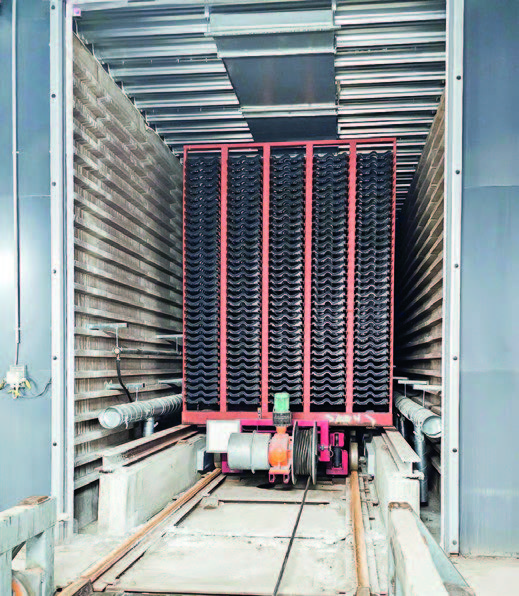
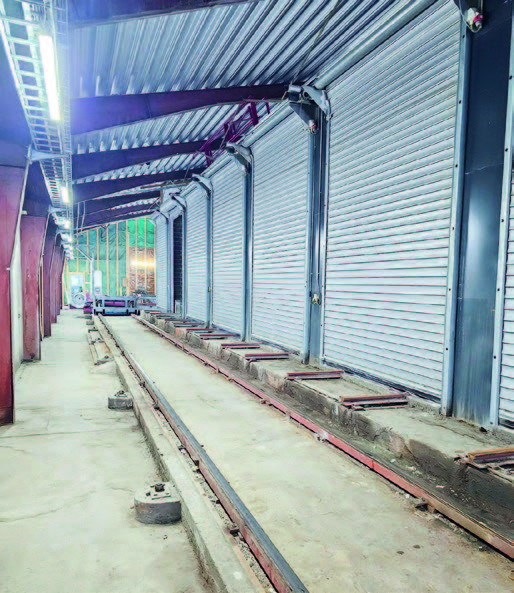
Individual curing chambers: Each chamber can be controlled separately to ensure optimum temperature and humidity conditions.
The integration of Kraft’s independent chamber curing technology marks not just a recovery from tragedy, but a leap forward in sustainability, performance, and resilience. Unlike clay tiles, concrete tiles are cured rather than fired, resulting in a lower carbon footprint—and with Kraft’s energy-efficient systems, IBF is a leader in sustainable building materials.
As the rebuilt facility returned to operation in Summer 2024, it symbolized more than just a return to business—it’s a testament to IBF’s adaptability, leadership, and vision. With high-performance curing systems, state-of-the-art automation, and a proud legacy behind it, IBF stands ready to shape the next chapter of the Danish concrete industry.